
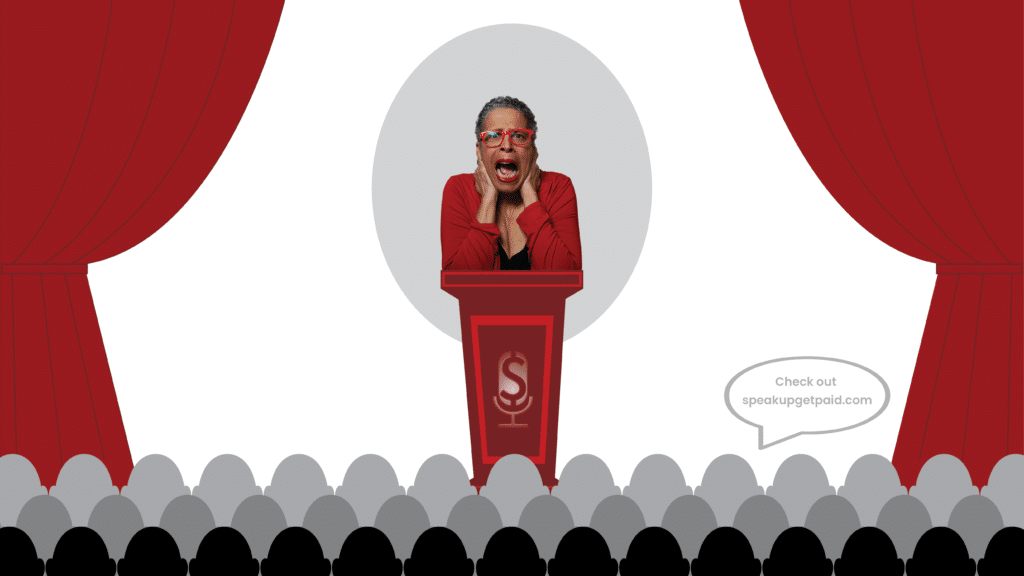
In the winter of 2018, I got an email from a member of my Toastmaster club.
“Dear Jackie,
Thanks for agreeing to evaluate my speech on Thursday. I look forward to hearing what you have to say.
One of my specific goals for this speech is to have more control of my nervousness, which led me to move around too much during my last speech.”
My first thought was “NOOOOOOOOOO!!!”
I didn’t respond like that, but I totally heard that Godzilla voice in my head when I read her words. I frantically wrote her an email that morphed into this speech.
I said, “Don’t try to control your nervousness, because you can’t.”
THIS may sound like bad news to some people. Don’t try to control your nervousness because you can’t.
The big fat lie we want to believe is that nervousness can be controlled.
Wouldn’t be fabulous if there was a pill you could take that transforms you into a calm, perfectly poised speaker? You’d show up to do your first or 200th speech, and you’d have a bit of apprehension or you’d get flushed, or perhaps you’d have some tummy butterflies and the shakes, or even a full-blown panic attack, and POOF! A genie or superhero would show up to hand you a tiny orange pill called “Nerves Away”, and something to wash it down. You’d pop it in your mouth and instantly feel invincible!
Unfortunately, there’s NO SUCH PILL.
Whether you are speaking live or online, the key to being a poised, powerful speaker and moving an audience is your willingness to be yourself as you share your message.
Speaking to an audience takes guts and your gut reacts to that reality.
When you’re live in front of an audience you feel like every eye is on you because every eye is. LOL!
It can be just as intimidating to speak to a video camera or in an online meeting.
When we’re nervous, it’s as if every part of us is reacting to those eyes and it shows up in sweats, stutters, and stammers. I used to get the shake-a-leg. I’d look cool and collected from above the podium, but one of my legs would be rattling around on its own like it was hoping to break free and run for its life.
You and I can’t control nervousness.
I’m living proof that you can mortally embarrass yourself in front of an audience and survive.
When I was in junior high school, I had a role in the seventh-grade class production of “A Raisin In The Sun”. I don’t even remember what role it was, but I had words to say in the play. Unfortunately, I did not learn those words.
On the most important day, the day when the 7th-grade class performed the play for the 8th-grade class, who was so much more grown-up and cooler than we were, I froze on the stage. I was paralytic, except for my potty mouth. I stood there like a deer at the end of a gun and cursed out my English teacher as she tried to feed me the lines.
Oh, the laughter from the cool kids. I was unprepared and way beyond nervous. I not only BOMBED. I set myself ablaze!
From that day forward, I vowed to disguise myself by never wearing my hair the same as I had on stage for the rest of the school year. I would hide my face when any 8th grader passed me in the hallway.
What you can learn from 7th grade me is to always be prepared, but the more relevant point is you will not self-combust when you are feeling nervous or absolutely suck in front of an audience.
Luckily, I have a technique and a few tips to surviving all those dastardly nervous sensations, and it doesn’t include any cussing.
IT AIN’T ABOUT YOU AKA SHIFT YOUR ATTENTION
The concept is to shift your attention. When you’re nervous about speaking, you’re typically thinking about how you will appear to the audience. We presume they’re judging us . . . …hey think I’m stupid.” “They know I’m nervous.” “They can smell my fear.” “They think my speech is boring.” “They hate me!”
When you’re thinking like this, your attention is completely focused on you. It is like you’re shining a flashlight on yourself. Shift your attention to them. Focus that flashlight on the audience and share your message as if your words might save their lives — no pressure. Lol! Or, as if your words are this incredible gift you want to make sure they receive.
Shifting your attention will take your energy off yourself and put it where it should be — on the audience. This is a much more powerful and possibly less nerve-wracking proposition.
It’s not about their eyes on you. Put your eyes on them. Look at them. Read the room. Are they getting your message? Are you making a contribution?
Nervousness is like a balloon on a bike pump. Each time you think about it and struggle with it, you’re pressing on the pump, and it’s getting bigger. Each time you focus your attention on who you’re talking to and what you want them to experience, it shrinks a little.
When you’re being present and listening with your eyes to see whether they are getting what you’re saying, the balloon deflates.
Whatever you put your attention on gets bigger so be vigilant where you place it.
You can be mindful of the distracting things we do when we are nervous like not looking at the audience, wringing, clutching or flailing your hands, rocking, clinging to the podium, etc. Try not to do or overdo those things, but let your nervousness be expressed however it comes out.
The part of you that’s nervous has to have its say. Oh, it will be present. It needs to bear witness to the things you fear not happening, like having the audience laughing at you, or yawning, or throwing tomatoes, or whatever your greatest fear is.
Your nervousness needs to witness evidence to the contrary. It has to see that you can get up here, speak, survive, and thrive!
Eventually, from being expressed, your nerves may subside. . . or not. You may still have the sensation of it. But, what you will have to counter this sensation is the experience of your own courageousness. The knowledge that you got up in front of the room with the jitters and you shared yourself because what you have to contribute is more important than letting your nerves stop you.
THREE TIPS FOR SPEAKING WITH NERVES
FACE IT: Stand in the face of your fear. Be nervous, let the sweat pour from your temples, let the butterflies dance in your stomach, turn red to the point someone in the audience is tempted to grab the water pitcher and pour it over your head. If your legs start rattling, let them. If that rattling drowns out your voice — you have a problem — just kidding.
However your nerves show up, let them. I will make you two promises. One, it will not feel good. Two, you will not die. You may wish that you were dead, but no one has ever imploded at the podium — Right?!!!?!?!
BREATHE: This seems simple enough, and I can assure you that you’re doing it anyway. Take deliberate breaths. A common thing to do when you’re nervous is to clench every little part of your body to try and control it. That often includes your breathing. Breathing is good. It grounds you. It calms you.
If you are particularly prone to forgetting to breathe when you’re nervous, have a plant, a person in the audience who is there to remind you. They can mouth the words B-R-E-A-T-H-E and it will help you to do so. Breathing also encourages you to pause which is an important public speaking technique that everyone should master.
SHOUT IT OUT: Tell the audience that you’re nervous. OMG, this is magic! It’s the ultimate homage to that part of you. It’s like winning a game of hide-and-seek with your nerves. You’re saying, “I see you!!!” Your nervousness is like a kid, it often stems from childhood. What kid doesn’t love a game of hide-and-seek?
Two things happen when you say to an audience, “I feel nervous.”
One, you connect with the audience. Every person, except for the odd sociopath in the audience, knows what nervousness feels like. They all have their own version of it. When you say, “I’m nervous”, it triggers their own experience and they’ll empathize with you. They’ll be on your side and may even be inspired by you because speaking in the face of your nervousness is an act of bravery.
The other thing that will happen is the ultimate expression of your nervousness. The nervous part of you is not trying to hurt you or undermine you. It’s trying to keep you safe. When you talk about it, it feels acknowledged and settles down. When you try and hide it, it will come out of every pore.
I didn’t bounce from that foul-mouthed kid in the seventh grade to standing on many stages and in front of numerous audiences without ever feeling nervous.
Is there anyone who never feels nervous about anything?
But I forced myself to face my nerves. I made myself get up in front of an audience as an entertainer and as a speaker because I wanted to make a contribution.

Learn key strategies for grabbing attention, keeping viewers hooked, and driving more sales!
Get this course!DO I STILL GET NERVOUS?
I don’t think nervousness ever goes completely away. I don’t get nervous very often. I’m not that “tweenager” anymore. I’d never sabotage myself by being unprepared. But the main reason is I know that anytime I get nervous, my attention is not in the right place. For me, nervousness is a call to action. It tells me “shift your attention, girl, and focus on making a contribution.”
The member who inspired this post took this idea to heart and was so calm during her speech, I forgot nervousness was an issue when I evaluated her.
That’s my wish for you. The next time you’re preparing to speak or find yourself in another situation that makes you nervous, don’t worry about trying to control your nervousness.
- Worry about your message.
- Think about how you want to impact your audience.
- Think about what action you want your audience to take once they hear your speak.
- Shift your attention to your listeners.
You may not be calm and perfectly poised. But I promise you will be a more powerful, comfortable, and confident speaker who connects with your audience.

Jackie Gordon
I've been creating outside-the-box ways to get paid for speaking and performing since 1998 and even won awards! I've been coaching speakers to speak more effectively for years. Now I want to help them get paid for it.
Learn key strategies for grabbing attention, keeping viewers hooked, and driving more sales!
Get this course!